
Know where your school stands—and what needs attention next.
Bring your leadership team's knowledge into one structured assessment. Understand your school's strengths, examine areas of concern, and prepare for more focused conversations with your board.
Free for a limited time. No payment required.
School results
IllustrativeRiverbend Community Charter (fictional) · School Assessment · Fall 2026 · Final
- Instruction78.4 Caution
- Administrative Leadership66.2 Caution
- Fiscal81.0 Healthy
- Governance63.5 Caution
- Compliance44.8 High Risk
- Student Performance69.1 Caution
- School Management76.3 Caution
- Mission and Key Design Elements82.7 Healthy
School-owned results. Sample data only — not a customer outcome.
A shared view for the decisions your team needs to make.
What deserves attention first?
Bring competing concerns into a structured view so your team can discuss priorities.
Are we seeing the same picture?
Use a common framework to organize perspectives across leadership and governance.
How do we explain where we stand?
Use a clear report to support board discussion and improvement planning.
From assessment to a more useful conversation.
- STEP 1
Bring the right people together
Involve the team members who understand your school's instruction, operations, finances, and governance.
Who's involvedIllustrative example- School leaderInstruction · Administrative Leadership
- Operations / business leadFiscal · School Management
- Academic leadStudent Performance · Mission and Key Design Elements
- Board memberGovernance · Compliance
- STEP 2
Complete the Diagnostic
Work through the eight pillars using your school's knowledge and available evidence.
Diagnostic workspaceDraft · in progress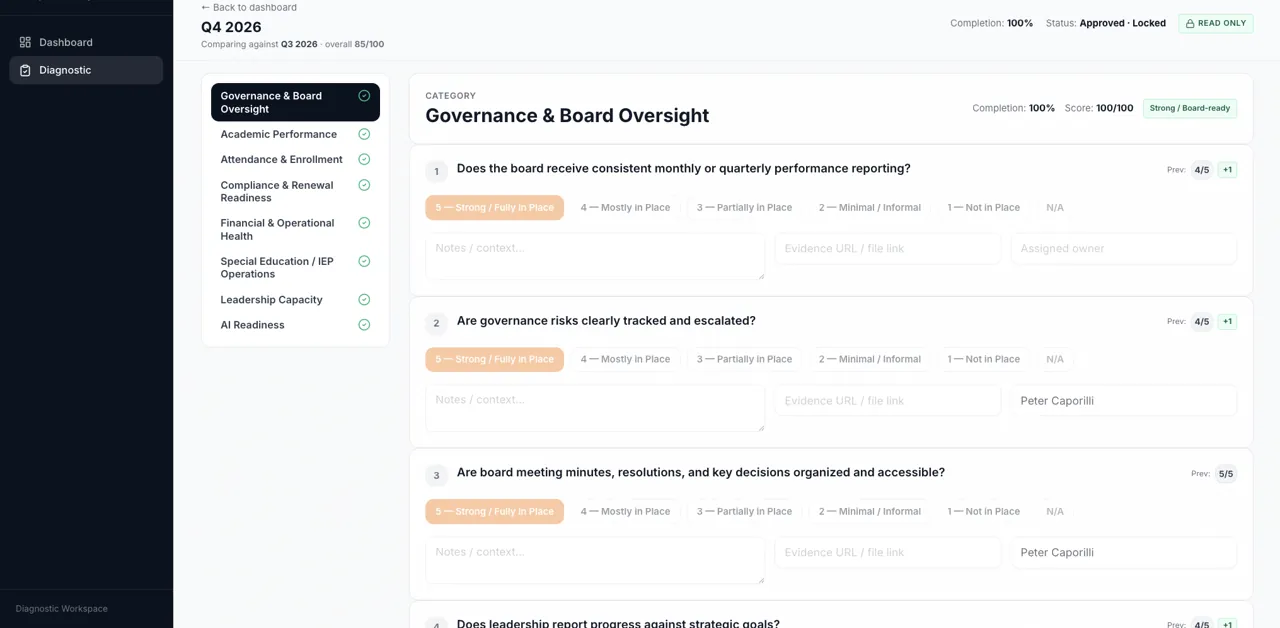
Each of the 115 questions is scored 1–5, with notes, an evidence link and an assigned owner.
- STEP 3
Review your priorities
Examine strengths and areas requiring attention, with results organized for discussion.
Board-ready dashboardFinal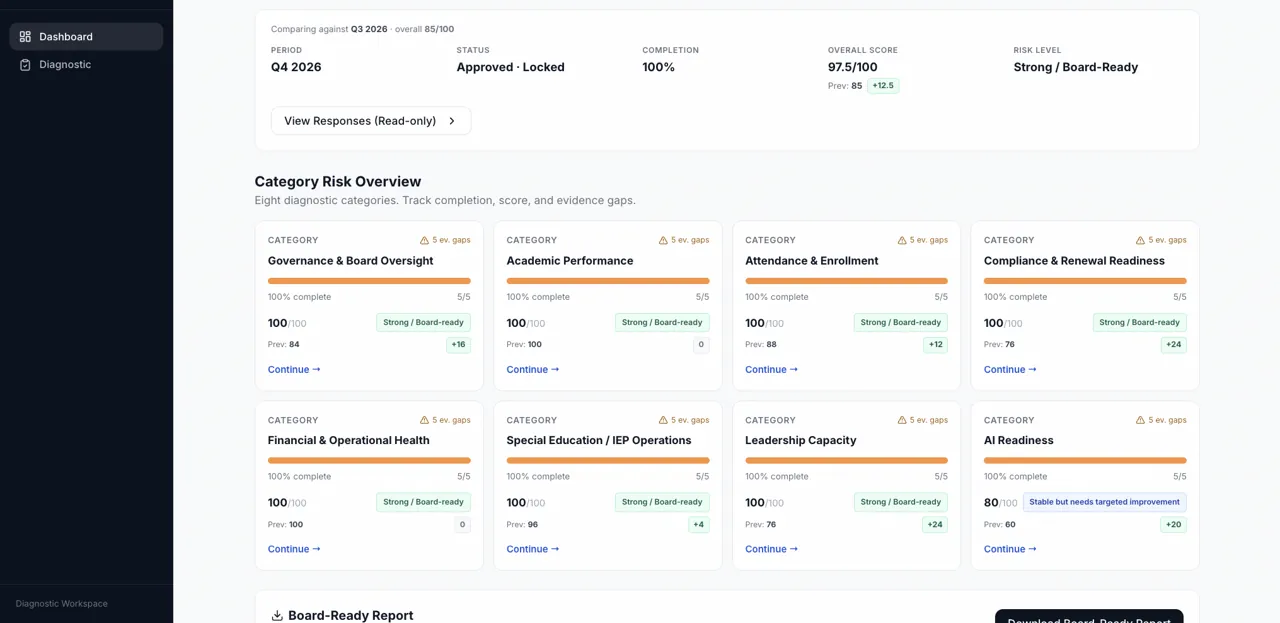
Overall score, eight pillar cards with risk indicators, evidence-gap counts, and a per-pillar delta versus the previous period.
- STEP 4
Agree on next steps
Use the report to guide improvement priorities and revisit progress through future assessments.
Leadership discussionIllustrative example- ComplianceAgreed to look more closely
- GovernanceDiscuss at next board meeting
- Next assessment periodRevisit progress
Example of what a leadership team might agree in discussion. Not generated by MySchoolRx.
A report your leadership team can use.
Use the results to focus discussion, examine supporting evidence, and decide where your team should take a closer look.
Riverbend Community Charter (fictional)
School Assessment · Fall 2026 · School-owned results
Risk levels by pillar
- Instruction78.4 Caution
- Administrative Leadership66.2 Caution
- Fiscal81.0 Healthy
- Governance63.5 Caution
- Compliance44.8 High Risk
- Student Performance69.1 Caution
- School Management76.3 Caution
- Mission and Key Design Elements82.7 Healthy
Top problem areas
- Compliance — 44.8/100 (High Risk)
- Governance — 63.5/100 (Caution)
- Administrative Leadership — 66.2/100 (Caution)
Compliance scope: authorizer reporting, evidence organization, and corrective action plan status.
Discussion priorities
Illustrative- Compliance — what evidence supports our authorizer reporting?
- Governance — is board reporting giving us the view we need?
- Administrative Leadership — where is workload concentrated?
Written by the leadership team for discussion. These are not product-generated recommendations.
A broader view of school health.
School health is complex, and not every factor has the same influence. Built on doctoral research into the conditions and practices associated with school quality, the model identifies the variables that matter most and gives them appropriate weight. Not a simple checklist: a weighted view of school health.
Instruction
Curriculum execution, classroom practice, intervention visibility, progress monitoring, and special-education service delivery.
Administrative Leadership
Executive workload, delegation, process maturity, and succession risk.
Fiscal
Budget visibility, grant tracking, vendor management, and operational bottlenecks.
Governance
Board reporting, oversight, accountability, decision documentation, policies, and by-laws.
Compliance
Authorizer reporting, evidence organization, and corrective action plan status.
Student Performance
Performance trends, attendance, and enrollment.
School Management
Management-organization oversight, vendor performance, and contract execution.
Mission and Key Design Elements
Alignment to charter mission, key design elements, and stated school model.
The School Health Diagnostic is designed to incorporate informed perspectives from people who understand different aspects of the school. Depending on the organization, this may include executive leadership, administrators and other designated participants.
The workflow allows schools to gather input and review the resulting Diagnostic before finalization.
Most teams complete the full Diagnostic, answering every question, in less than 30 minutes. Adding supporting evidence takes additional time.
Yes. You can stop at any time and pick up right where you left off.
Your report shows your school's overall score out of 100 and its risk level, how complete the assessment is, and how much supporting evidence is missing. A pillar health heat map and a table of risk levels by pillar show where each of the eight pillars stands: Healthy (80 and above), Caution (60–79) or High Risk (below 60).
The report then lists your top problem areas, followed by a corrective action roadmap and next steps.
Access to school information is controlled according to authorized users and roles.
The School Health Diagnostic focuses on organizational school-health information and does not require individual student records as part of the Diagnostic.
The Founding Partner program is free for a limited time. No payment is required to join.
Participation does not guarantee permanent free access or delivery of a particular future feature.
Give your next leadership discussion a clearer starting point.
Become a Founding Partner and explore how MySchoolRx can help your school understand its priorities.
Free for a limited time. No payment required.
Oversee multiple schools? Explore the Portfolio experience.